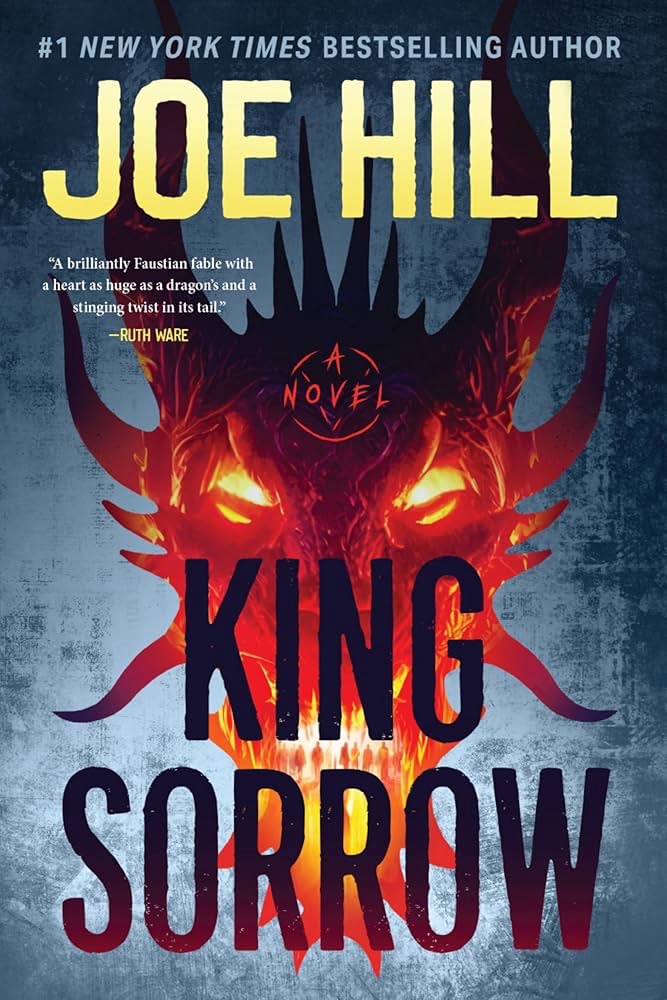
King Sorrow asks the question: Who gets to pick the next right thing? This novel tangles up morality and our knee jerk reaction to what is right, and what is wrong, and in some cases, very, very, wrong.
I say all that to say: this book is incredible. I read and listened to it, and it didn’t miss a single opportunity to shine.
Before I get into the meat and potatoes of this book, I should give you an idea of why you want to read this book (other than because I recommended it on my super awesome blog).
Let’s get into it!
Read King Sorrow by Joe Hill if the following things appeal to you:
- A mishmash of random bits of nightmare fuel shoved into a container of an extremely well structured, well plotted, and obviously loved novel.
- Morally grey, morally grey, morally grey plot lines.
- Characters being addicted to power, and just about anything else on offer.
- Intense, real human relationships and heartbreaks despite the fact that one of the main characters is an ancient dragon.
I could go on, but I don’t want to risk actually spoiling anything.
What’s the gist of King Sorrow and why do I love it?
Pretend that I am scooting my chair up next to you, and putting my tiny hands over yours as I whisper, “I love it because it’s fucking brilliant.”
The story starts with Arthur Oakes, an ambitious student at Rackham College that is entrusted with the keys to the college’s impressive and historic library. At this point, things are looking up for Arthur. He’s going to graduate soon and move to London, his mother might be up for parole, and he might even be at the start of a romance with a girl that is objectively his intellectual equal despite her ‘townie’ education.
A shiny, neatly wrapped future is shining on Arthur— until it abruptly doesn’t. A visit with his mother at the prison has him crossing paths with Jayne Nighswander.
Jayne is a local drug dealer, a pimp for her younger sister, and the daughter of an infamous criminal that just so happens to be in the same women’s prison as Arthur’s activist and minister mother.
Desperate after she loses thousands of dollars worth of product, she approaches Arthur and tells him that she needs him to steal some of the precious books in the college’s library, or Arthur’s mother might just have a few accidents at the hands of Jayne’s mother and her goons.
Obviously, the choice isn’t really a choice, and Arthur’s love of literature and academia can’t outweigh what he thinks, as some of his AA bound friends say later in the story, is the next right thing.
He starts stealing books.
Jayne keeps moving the goalposts, telling him that she can’t move these books for their real value because she’s got an illegal connection in Boston that’s buying them off her for a quarter of their actual worth.
Arthur shoulders this burden alone, until one night, a confrontation with Jayne and her goons, has Arthur’s best friends pulled into the mix. With the knowledge that this townie drug dealer is holding Arthur hostage, his friends Colin, Alison, Donna, Donovan, and Gwen resolve to get him out of this situation.
Arthur is at times cowardly, and is sometimes prone to giving into the more hedonistic choice and we often wonder if he’s even the good guy or if he’s just the vehicle for something bigger.
Something bigger like King Sorrow.
Without spoiling too much, using an old artifact found in Colin’s grandfather’s library, the gang summons King Sorrow, a thousand year old dragon that promises to grant their wishes. They think that they’ve found the answers to their problems, and they almost immediately wish for Jayne Nighswander to disappear from their lives.
But when the business with Jayne is over, King Sorrow expects the gang to make good on their end of the bargain: pick someone for him to kill on the same day every year so that he can devour their soul, or they can count on dying themselves.
The story starts in the U.S. in the 1980s, and moves along with the 90s, 2000s, and 2010s serving as a back drop.
Each year, regardless of the kind of people the members of the group are turning into, meaning the kind of people that carry an unchecked power with them, they meet to discuss who they’re going to kill.
That’s about all I’m willing to give away at the moment. You have to read this.
The book has a delicious ending, one that will have you saying, “Oh hell no, Mr. Hill.”
Onward!
So I’ve got a lot of things planned for this year, writing-wise, I’m hoping to share a couple of projects with you guys in the next few months. It is my intention to post on the blog more, because I’m constantly reading but something needs to blow me away to make it onto the blog.
Also, I’m just forgetful and not the best at organizing things.
If you want me to read your book to maybe see it on the blog, reach out to me at alicia@ajcreads.com. If you have a question or just want to say hi, go ahead and shoot an email my way still! And please subscribe to this blog so that you don’t miss a book rec!
And if you would like to contribute to my efforts to stay alert enough to remember to write these blog posts after an amazing book, you can send me a coffee on my kofi page here.
See you next time!






 ajcreads