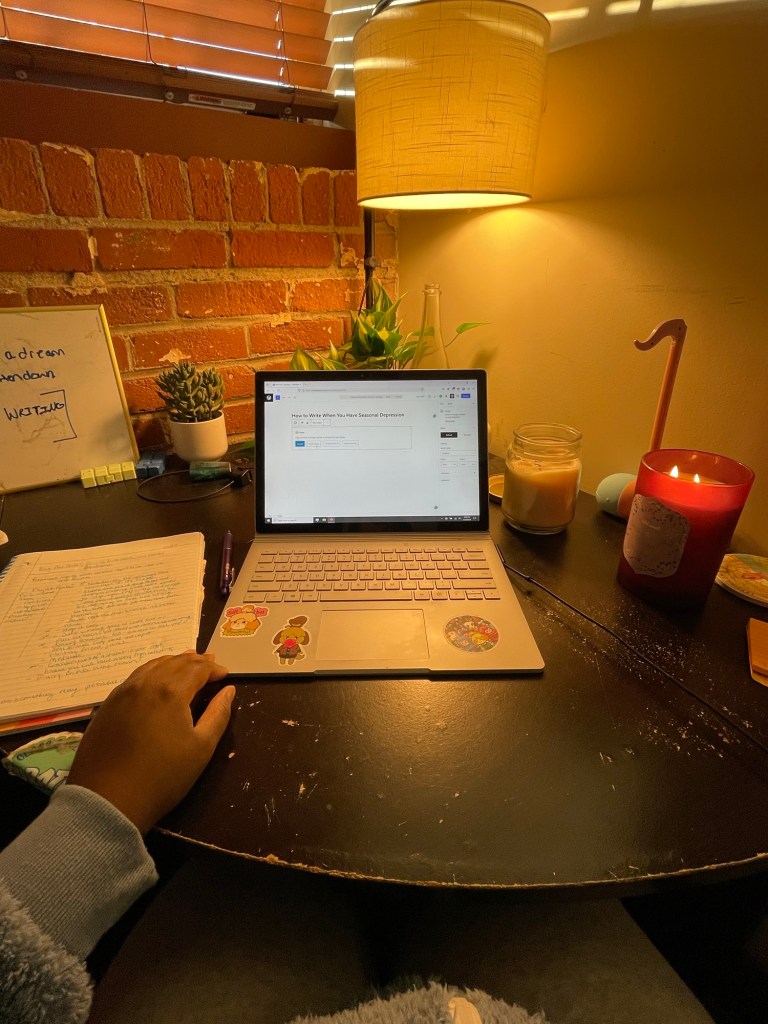
Hello, readers! I come to you with a humble blog post about writing when you feel like you can’t go on. I have written professionally for years, and every year, I’m faced with what Adam Gnade has coined the Big Sad.
It’s the same every year. I lose motivation to do fuck all but eat, drink coffee, and eat again. I’m snappier and I’m harder to love, but I can tell you that I can avoid being either of those things when I’m writing. I’m not myself when I’m not writing. I put on my people suit and go to work, and pretend to be the kind of person that would be happy working for someone else for the rest of my life.
But there’s no fooling myself. Or my loved ones.
If you are a writer, to survive the winters, you must write.
Easier said than done, especially when you’re constantly beating yourself up over all the writing you haven’t done. So, here is my advice to you, things that I have learned the hard way when it comes to the beautiful art of writing. (I don’t know why more people don’t call writing an art, but instead a craft)
Take Advantage of Your Upswings
Most folks with seasonal depression tend to have very good days and very bad, rotten days. When you find yourself graced with a good day, go to your writing desk. Or couch. Or closet (more on a good writing space later).
The feeling of having written will carry you through on the bad days like a lifeline. Writing will ultimately give you purpose. And you don’t have to write for a super long time, either!
On my worst days, I can only manage a 5 minute writing prompt or brain dump. But I at least give myself my best chance, and I sit down at my desk. It is not easy, and it takes a lot of buildup. Some days coffee is the only thing that brings me there.
Sensory Goodness
I’m neurodivergent in a lot of ways. I won’t get into it here, but essentially, my senses are more easily agitated than neurotypical people. I can’t stand the sound of the kid running upstairs when it is comparatively a low mumble to my husband, who’s neurospicyness allows him to ignore it with the help of a pair of noise cancelling headphones. Strong smells inspire anger, and being too hot or too cold drives me nuts.
Invest in the things that make it easier to be at your desk. Create a soft environment with just a little clutter. Light a candle (or two), and throw on some earbuds. As I write this, I’m listening to lofi hip hop beats through my over ear headphones. I’m wearing a comfortable pair of sweats, and a fluffy jacket and my hair is in plaits. I look like a complete ragamuffin. But that’s what I need to work.
Start Meditating
I recently started meditating again and it has been life changing. My low mood has improved and I look at things with more optimism. I only mediate in 3 minute spurts using an app, and it works wonders for me. I also practice rectangle breathing (breathe in the nose for 4 seconds, hold for 2, then out for 6).
Meditation has cleared my mind enough to be clear about my goals and what I hope to accomplish with my writing. It’s also been a way for me to take it easy when it feels like I should be writing.
Become a Student in Your Craft
I know I said writing should be called an art earlier, but you get the idea. I love nothing more as a form of productive procrastination than acting as a student. I read books on writing, do writing exercises, and read magazines to see what other writers have accomplished. A particularly good book about writing instruction is Natalie Goldberg’s Writing Down the Bones. She takes a Zen approach, and it’s a great, easily digestible read with some lessons on writing.
Writing courses are expensive, so if you want to be a writer, learn all that you can from books.
No News Unless It’s Book News
Oof. Easier said than done. I try to limit my news viewing, especially post-election. I let myself read as much book news about publishing, and all the new stuff coming out by reading about it on sites like Book Riot. I like to wrap myself in a cocoon where books are my only reality.
Read, Read, Read
If you can’t manage to make it to your desk, or sofa, or coffee table to write, then read a book. And read lots of them. When you’re reading a book, you’re still learning how to be a writer but without the excruciating feeling of trying to get blood out of a rock when you sit down to write and it just isn’t happening that day.
Read widely. Go to bookstores and libraries, get an e-reader, or listen to audiobooks. One of my defense mechanisms against the Big Sad is that when I get up in the morning before the intrusive thoughts start to settle in, I put on my over-ear headphones and listen to an audiobook or a podcast about writing.
Now, Go and Write!
After reading this post, I hope you feel more confident about your writing practice. If you don’t, I’m sorry. Just know I am here with you and you are not the only one struggling to get things done. Feel free to leave a comment on how you manage your writing practice throughout the winter months.
Till next time!
Alicia
Discover more from ajcreads
Subscribe to get the latest posts sent to your email.
 ajcreads